Showing posts with label Solanaceae. Show all posts

Sunday, July 21, 2024

Solanum diphyllum L.


Family – Solanaceae

Synonym – Pseudocapsicum diphyllum (L.) Medik. 

Vernacular names – Two leaf Nightshade

Habit – Herb

Habitat – Grown as medicinal plant

Distribution – Native of Central America

Flowering and Fruiting –  January-June

Key Identification Features – This subshrub has elliptic to oblong leaves, white flowers, and orange-yellow fruits. The leaves are unequally paired, with a rounded apex and attenuated base. The corolla has five glabrous lobes, and the fruit contains yellow or tan reniform-discoid seeds.

Uses – It is cultivated for its ornamental foliage and bright yellow fruits. It has medicinal uses in Mexico but contains toxic alkaloids, so caution is advised.


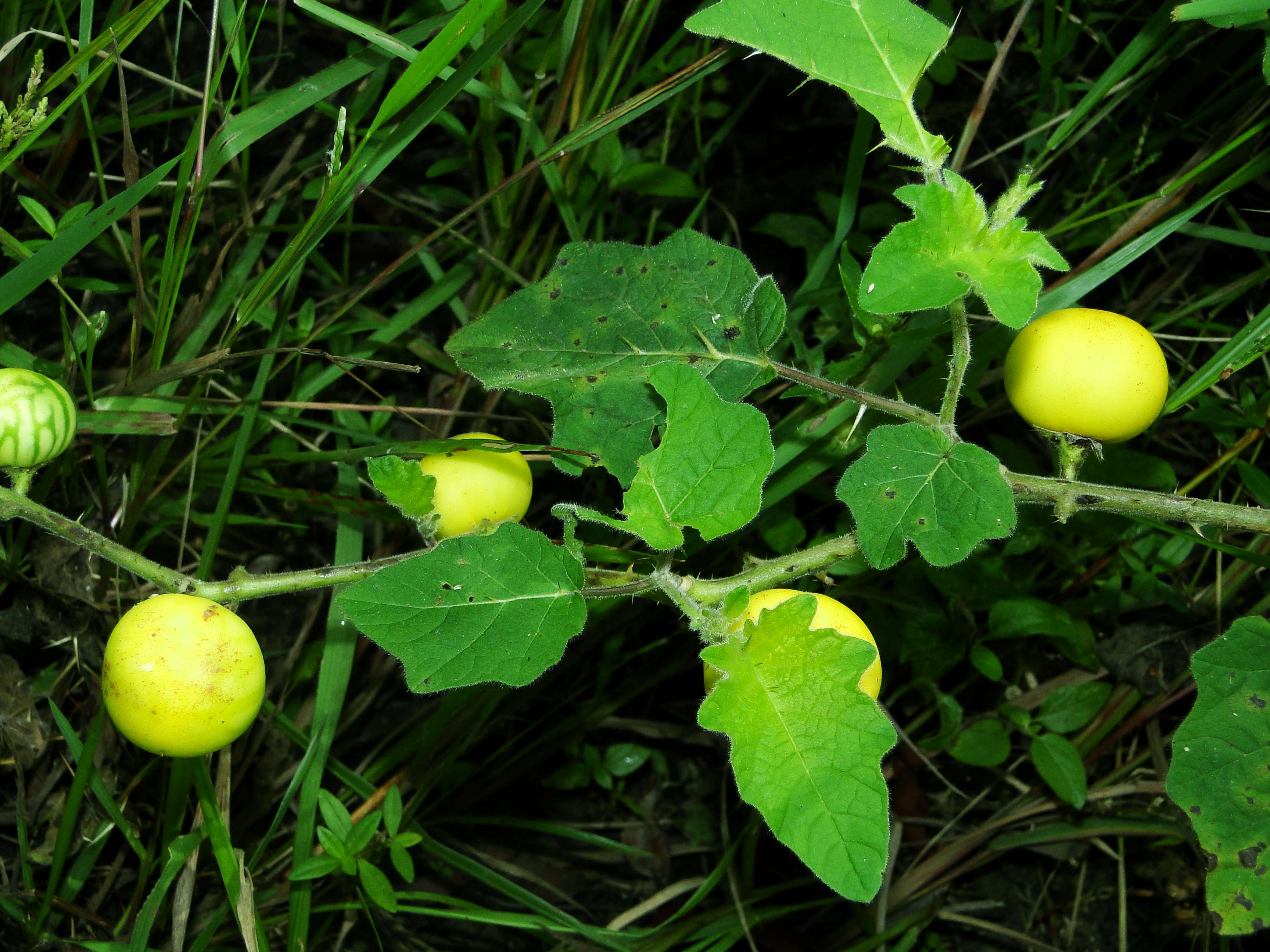
Solanum viarum Dunal


Family – Solanaceae

Synonym – Solanum chloranthum DC. ; Solanum khasianum var. chatterjeeanum Sengupta ; Solanum viridiflorum Ruiz & Pav.

Vernacular names – Chruvazhuthina

Habit – Shrub

Habitat – Degraded evergreen forest areas

Distribution – Native of South America

Flowering and Fruiting – August-April

Key Identification Features – This pubescent shrub has recurved prickles up to 7 mm long. Its ovate leaves are irregularly shallowly lobed, sinuate, and densely tomentose on the lower surface. The flowers form cymes with 3 or 4 blooms, and the fruit is a yellow, globose berry measuring 3 cm across.

Uses -  It produces golf ball-sized fruits with yellow skin and reddish-brown seeds.


Wednesday, July 3, 2024

Physalis angulata L.


Family: Solanaceae

Synonym: Physalis minima L. 

Vernacular name: Njodinjotta,Notinotta

Habit: Herb

Habitat: It is a common weed in open areas, rice field, road sides etc

Distribution:  Tropical Asia, Africa, Australia

Flowering and Fruiting: July-January

Key identification features: Annual herbs with angular branches and leaves are simple, alternate, and can be ovate or elliptic-lanceolate, Flowers are axillary and solitary. The corolla is pale-yellow with a purple base.The stamens are unequal, numbering 5, with oblong anthers. The ovary is globose and style is linear, and the stigma is obscurely 2-lobed. Fruit is a berry.

Uses: Ripe fruits are eaten raw which is sweet scented and delicious.


Solanum americanum Mill.


Family: Solanaceae

Synonym: Solanum nigrum var. americanum (Mill.) O.E.Schulz 

Vernacular name: Eradakukkeera, Karimthakkali, Mullakuthakkali, Manathakkali

Habit: Herb

Habitat: Degraded moist deciduous forest areas and riversides, also in the plains

Distribution: Tropical and subtropical America, maturalised in many tropical Asian and African countries

Flowering and Fruiting: March-November

Key identification features: This plant is an erect annual herb with glabrous or sparsely hispid stems. Its leaves are ovate or elliptic. The inflorescence occurs in axillary to extra-axillary umbellate cymes, with a white corolla. The berry is globose,  and appears purplish-black.

Uses: The leaves have been used to treat stomach disorders and Bright's Disease.


Datura stramonium L.


Family: Solanaceae

Synonym: Stramonium vulgatum Gaertn. 

Vernacular name: Ummam

Habi: Shrub

Habitat: Scrub jungles and wastelands

Distribution: North America, India, Temperate regions

Flowering and Fruiting: July-September

Key identification features: Plant 60-120 cm or more tall, branched, pubescent; Leaves ovate or broadly so, sinuately dentate, minutely puberulose. Corolla white or purplish Capsule erect, spiny and densely pubescent. Seeds reniform, reticulate-foveolate, and black.

Uses: It is well-known as a treatment for chest complaints, including asthma, cough, tuberculosis and bronchitis.


Solanum torvum Sw.


Family: Solanaceae

Synonym: Solanum acanthifolium Dunal 

Vernacular name: Anachunda, Cheriyamodumutticka, Chithiramchunda, Chunda,

Habit: Shrub

Habitat: Degraded forest areas and also in the plains

Distribution: Throughout the tropics

Flowering and Fruiting: July-March

Key identification features: Shrubs up to 2 meters tall with stellate-hairy stems and ovate-oblong leaves. The white flowers are arranged in corymbose cymes, and the globose berries are pale green, turning dull orange. Seeds discoid, smooth.


Solanum capsicoides All.


Family: Solanaceae

Synonym: Solanum macowanii Fourc. 

Vernacular name: Rakthachunda

Habit: Herb

Habitat: Degraded forests and waste places

Distribution: Native to South America; now naturalised in other parts of tropics

Flowering and fruiting: September-January            

Key identification features: These plants have hairy leaves and straight spines along the midrib and main lateral veins. The flowers are with orange anthers and depressed globular fruits are depressed globular.

Uses: The fruits, charred and pounded in oil, are used to treat skin complaints.The pounded roots have been applied to the gums as a remedy against toothache.


Blechnum orientale L.

  Family : Blechnaceae  Habit : Subshrub Habitat : Wet tropical biome Distribution :   Western Australia and Southern Asia Flowering...